

Take control of your child’s vision.
What is Myopia?
Myopia, commonly known as near-sightedness, is a chronic and progressive condition characterized by a person’s inability to see distant objects clearly. In this condition, the eye elongates excessively, causing distant objects to appear blurry while close objects remain clear. Myopia can potentially lead to further eye health complications and vision loss later in life.
A GUIDE TO UNDERSTANDING MYOPIA AND RESEARCH BASED OPTIONS TO SLOW DOWN MYOPIA PROGRESSION.
Why Do We Care?
By 2050, the prevalence of myopia is predicted to be 50% of the world’s population with 1 Billion to be high myopes.
Why is Management Important?
While eyeglasses will help a child see better, it will not address the eye health implications myopia often creates.
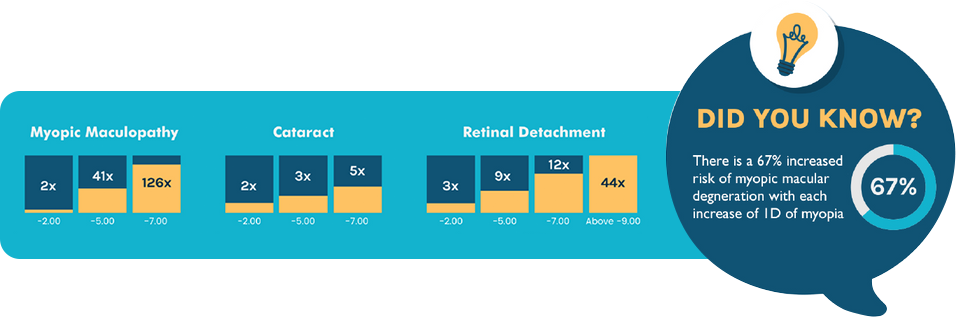
Myopia often causes the eye to become more elongated and as a result, increase a child’s risk of developing vision threatening conditions such as retinal detachment, myopic macular degeneration, cataracts, and glaucoma; all conditions that can lead to permanent vision loss.
How Can Myopia Be Prevented?
Check yearly.
Bring your child to see an optometrist annually to identify any signs of early myopia, so that intervention can be initiated to slow or prevent myopia.

Get outside
Outdoor play for at least 90 minutes a day can reduce the risk of myopia.
For one additional hour spent outdoors each week, the odds of being myopic are lowered by 14.3%.

Limit screens
Try to limit leisure screen time to 2 hours per day in school-aged children.
Spending too much time on close work and digital screens will increase the risk of myopia.

Take breaks
Take regular breaks from reading and screens to avoid eyestrain.
Follow the 20-20-20 rule: every 20 minutes take a 20 second break to look at something 20 metres away.

Arms out
Holding reading material, such as books or handheld digital devices too close, may cause eyestrain and increase the risk of myopia.
What Can be Done to Slow Myopia

While there is no set cure for myopia, recent research has identified proven intervention options to help slow down the progression of myopia; some by 50% or more.
BEST
Atropine 0.05% Eyedrops
NaturalVue® Multifocal Contacts
CRT Overnight Rigid Contacts
Stellest (Aspherical Lenslet Technology)
Slows myopia progression by over 50%
NaturalVue daily contact lenses are child-friendly and cost ~$212 per 90 days. CRT rigid lenses reshape the cornea overnight for clear daytime vision; best for mild to moderate myopia, they cost $1,425 initially with $538 yearly refits. Stellest glasses create peripheral myopic defocus that helps slow myopia progression.
BETTER
Atropine 0.025% Eye Drops
Slows myopia progression by 25–35%
Low-dose atropine from compounding pharmacies slows myopia progression, costing $5–$50 monthly. Studies show 0.05% works best with few side effects, while 0.025% balances effectiveness and comfort. Children generally need Transition lenses for light sensitivity and EyeZen or Progressive lenses for focusing support.
GOOD
Atropine 0.01% eye drops
Progressive / EyeZen Glasses
Slows myopia progression by 10–20%
Progressive and EyeZen “anti-fatigue” lenses reduce eyestrain and improve comfort for near work, but generally have a small effect on slowing myopia.
In children with esophoria or poor focusing ability, they may provide up to a 20% reduction over 3 years.
NOT EFFECTIVE
Single Vision Glasses or Contacts
No effect on slowing myopia progression, but going uncorrected or under corrected speeds up rate of change
Always keep children in their current prescription, as under correction can speed myopia. Ages 8–12 in particular may need updates more often than yearly, so 6-month checks are recommended. Lens remakes are discounted 30% off (without insurance).
Our Services
Contact Info
Hours of Operation
- Monday 8:00am - 5:00pm
- Tuesday *8:00am - 5:30pm
- Wednesday 8:00am - 5:30pm
- Thursday 8:00am - 5:30pm
- Friday 8:00am - 5:00pm
- Saturday Closed
- Sunday Closed
- Monday
- Tuesday
- Wednesday
- Thursday
- Friday
- Saturday
- Sunday
- Monday
- Tuesday
- Wednesday
- Thursday
- Friday
- Saturday
- Sunday
*1st Tue of Month 9:00am - 5:30pm
© 2026 Cedar Rapids Eye Care. All rights Reserved - Accessibility Statement - Privacy Policy - Sitemap
Managed and Designed by 